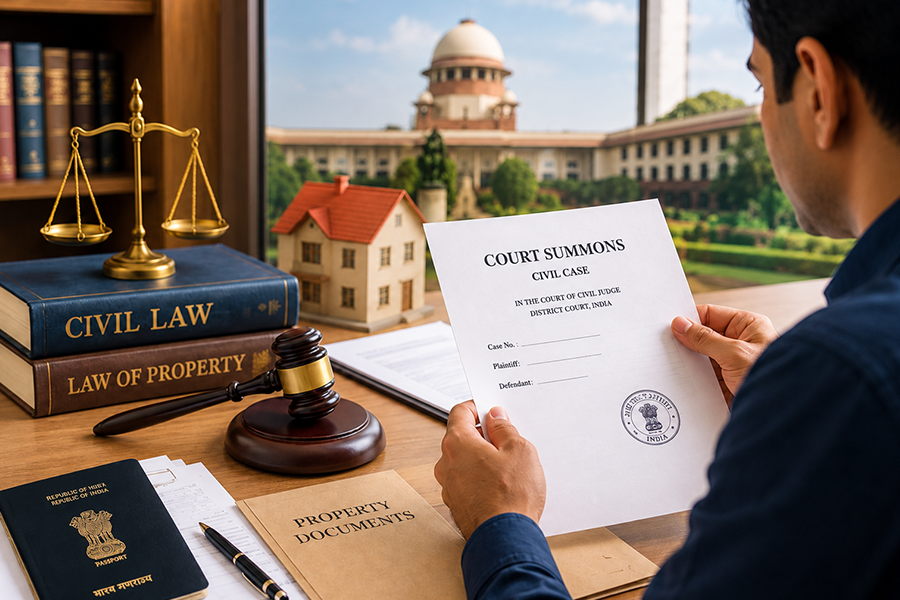
An NRI may become involved in civil proceedings in India concerning property, inheritance, tenancy, family settlements, contracts or business transactions. The first information may come through a legal notice, court summons or even a call from a relative in India.
The matter should never be ignored simply because the person lives abroad. If valid court notices remain unanswered, the court may proceed ex parte, and the NRI could lose the opportunity to contest allegations, produce documents or oppose an interim order.
What Should an NRI Do?
The first step is to understand exactly what proceedings have been initiated and what action may be required. An NRI should promptly verify the following:
- The court and case number
- Nature of the claim
- Parties and property involved
- Next hearing date
- Whether any injunction or interim order has been passed
Can an NRI Be Represented Without Being in India?
An Indian advocate can generally represent the NRI in appropriate proceedings, so personal attendance may not be required at every hearing.
Where necessary, the NRI may appoint a trusted representative through a properly executed Power of Attorney. However, personal participation or evidence may still be required at certain stages depending upon the nature of the proceedings and directions of the court.
Civil Disputes That Require Particular Attention
Certain disputes involving NRIs can become particularly complicated because the property, family members, records and proceedings are located in India while the owner is living overseas.
Partition or Inheritance
Disputes concerning ancestral property, succession, inheritance or partition may require careful examination of title and family records.
Wills & Family Settlements
Wills, family settlements and related documents should be reviewed carefully to understand the rights and obligations of the parties.
Property Possession & Encroachment
Possession disputes, unauthorised occupation and encroachment can become difficult to manage when the owner is living outside India.
Tenants & Caretakers
Disputes involving tenants, caretakers or occupants may require prompt verification of the property's current status and supporting records.
Cancellation of Documents
Disputes involving sale deeds, Powers of Attorney or other property documents should be addressed through the appropriate legal process.
Builder & Contractual Disputes
Construction, development and contractual disputes may require document verification and coordination with professionals in India.
Obtain the Complete Case Record
Once an NRI learns about a civil case, it is important to obtain and review the complete case record rather than relying only on information received from relatives, intermediaries or informal sources.
Relevant pleadings, notices, orders, applications and supporting documents should be collected and reviewed so that the NRI has a clear understanding of the allegations and the relief being sought.
Preserve All Relevant Documents
Property documents, agreements, correspondence, payment records, tax receipts, Power of Attorney documents, family settlement documents and other relevant records should be preserved carefully.
Do not wait for a dispute to become complicated before organising the documents that may support your position.
— MOOV INC ADVISORYCheck for Any Interim or Restrictive Order
An NRI should also verify whether the court has passed any interim order affecting the property or transaction.
In particular, it is important to check whether any restriction has been placed on the sale, transfer, possession or use of the property.
Can the Matter Be Settled?
Depending on the circumstances, mediation or settlement may be explored. Alternative resolution can sometimes help parties avoid prolonged litigation and reduce the practical difficulties of managing a dispute from overseas.
However, any settlement should be properly documented and should be stamped and registered wherever required. The legal effect of a settlement depends on the facts, applicable law and the nature of the documents involved.
Distance Should Not Weaken Your Position
For an NRI, the real difficulty is often coordinating with courts, lawyers, relatives and local government offices from thousands of kilometres away.
Being outside India does not mean that a civil dispute should be ignored. Timely information, proper documentation and appropriate legal representation can help an NRI respond to proceedings in an organised manner.
If you receive information about a civil case in India, act promptly. Verify the facts, protect your documents and respond through the appropriate legal process.
— MOOV INC ADVISORYConclusion
A civil case in India should never be ignored merely because the defendant is living abroad. Understanding the case, obtaining the relevant records, preserving documents and taking timely legal advice can help protect an NRI's interests.
The sooner the situation is verified and appropriate steps are taken, the better positioned the NRI may be to respond to the proceedings.
Distance should never become a disadvantage when protecting your rights and assets in India.
MOOV INC ADVISORY
NRI Facilitation Cell
Disclaimer: This article is for general information only and does not constitute legal advice. Rights and remedies depend upon the facts, applicable law, limitation periods and orders passed by the competent court. Please consult a qualified legal professional for advice relating to a specific matter.