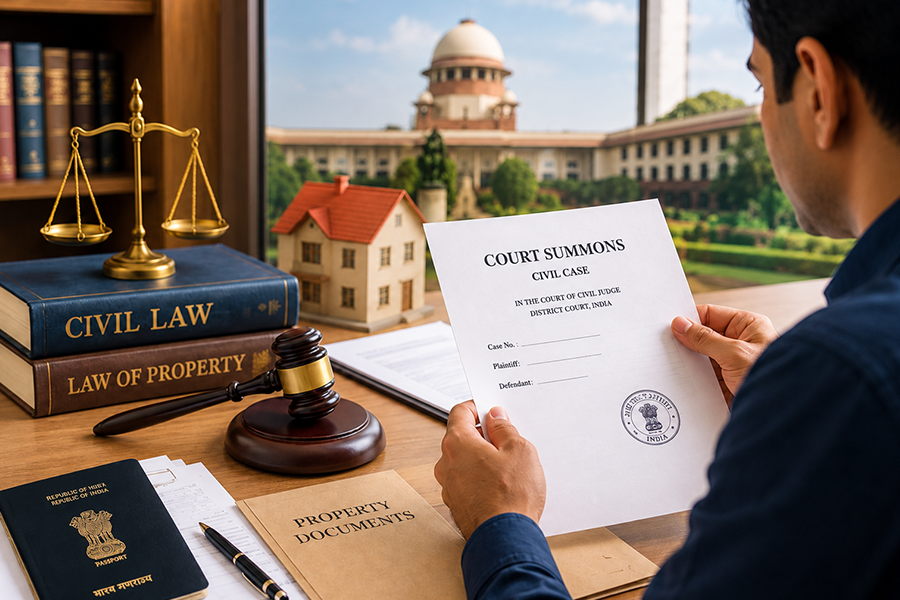
Ask any Non-Resident Indian what troubles them most about the life they left behind, and you will hear the usual suspects: the long flights, the jet lag, the missed weddings, the ageing parents on the other end of a video call.
Distance, everyone assumes, is the great enemy of the NRI experience.
They are wrong. Distance is a solvable problem. Airlines fly every day. WhatsApp calls are free. A flat can be reached from Dubai or Detroit in under twenty-four hours if it truly must be.
What cannot be solved with a plane ticket or a phone plan is the deeper, quieter problem that sits underneath almost every NRI's anxiety about India: not knowing who to trust on the ground.
The biggest problem for an NRI is not distance. It is not knowing who to trust on the ground in India.
— Vivek Krishan SoodThe Real Distance Is Not Geographic
Consider the NRI who owns an ancestral property in a small town outside Lucknow. He has not seen it in eight years. He does not know if the tenant is paying rent, if the property taxes are current, if a distant cousin has quietly filed a claim on it, or if the caretaker he pays every month is doing anything at all.
The kilometers between him and that property are irrelevant. What separates him from that asset is information, verification, and a reliable set of eyes and hands he can rely on.
This is the story that repeats itself across nearly every NRI household, in nearly every domain of life back home:
Property
Who is checking that the house is not encroached upon? Who is verifying the sale deed before money changes hands?
Parents
Who is making sure the domestic help hired for an ageing mother is trustworthy? Who accompanies her to the hospital when a report needs to be understood, not just collected?
Legal & Financial Matters
Who is following up with the lawyer who has gone silent for three months? Who is confirming that the mutual fund paperwork was actually submitted and not lost in a drawer?
Family Disputes
Who is a neutral, capable presence when a property dispute among siblings needs someone level-headed to mediate or at least document?
Why This Problem Is So Hard to Solve
The instinctive solution is to lean on family. A brother, an uncle, a childhood friend. But this creates its own quiet tragedy.
Family relationships were not built to carry the weight of financial oversight and legal follow-up.
Asking a sibling to "just check on the property" repeatedly, indefinitely, without compensation or formal accountability, strains the relationship in ways that often go unspoken until they erupt.
Many NRIs will privately admit that the person managing their affairs in India is also the person they now avoid discussing money with at family gatherings.
The alternative — hiring local agents, lawyers, or property managers — comes with its own trust deficit.
There is no institutional mechanism for an NRI sitting in London or San Jose to verify a stranger's credibility from ten thousand kilometers away.
- Reviews can be fake.
- Referrals can be biased.
- Recourse can be slow and difficult from abroad.
This is the trust vacuum. It is not caused by any one bad actor. It is a structural gap — a missing layer of dependable, verifiable, professional presence between the NRI abroad and the reality on the ground in India.
What Filling This Gap Actually Requires
Solving the distance problem took technology: faster internet, video calling and digital banking.
Solving the trust problem requires something different — infrastructure of a human kind.
It requires:
Verified, Accountable Local Representation
People or organizations whose work can be checked, whose credentials are real, and who operate under professional or contractual accountability rather than goodwill alone.
Transparency by Default
Regular, documented updates including photos, receipts and written confirmations rather than a phone call that simply says, "don't worry, it's fine."
Neutral Third-Party Status
Someone who is not a family member, so that the relationship of trust is professional and can be enforced rather than emotional and easily strained.
Local Expertise
An understanding of how systems in India actually work today, translated clearly for someone who has been away for years.
This is precisely the gap that a new generation of NRI-focused services — from property management companies to concierge legal services to dedicated relationship managers — are beginning to fill.
But the sector is still young, and most NRIs are navigating it through trial, error, and expensive lessons learned the hard way.
The Real Ask
NRIs do not need to be closer to India. Many of them are, in fact, emotionally closer to India than people who never left.
What they need is a way to extend their own judgment and diligence into a place they cannot physically be.
They need eyes they can trust, hands they can rely on, and a system that tells them the truth even when the truth is inconvenient.
— Vivek Krishan SoodConclusion
Until that trust infrastructure matures, every NRI will continue to feel the same quiet unease — not because India is far away, but because somewhere back home, an important decision is being made, or an important asset is sitting unattended, and there is no one they are entirely sure they can trust to watch over it.
That is the real distance. And it has nothing to do with miles.
Vivek Krishan Sood
writes on the challenges and evolving support systems
for the Non-Resident Indian community.
This post is intended solely for general information and awareness. It does not constitute legal, financial, property or professional advice. Readers should consult qualified professionals for advice specific to their individual circumstances.
— Disclaimer