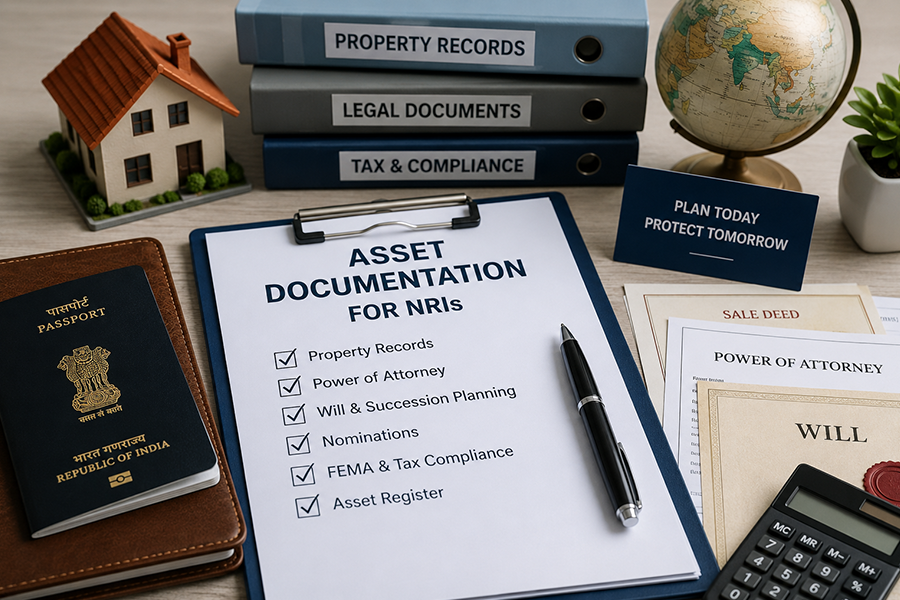
Living abroad while holding assets in your home country creates a peculiar kind of risk: distance. You're not there to check on things, sign papers quickly, or catch a problem before it grows.
For Non-Resident Indians (NRIs) — and NRIs elsewhere in the world facing similar situations — this makes documentation not a bureaucratic afterthought but a genuine safeguard for wealth and family peace.
Here's why paperwork deserves far more attention than it usually gets, and where things commonly go wrong.
1. Property Records Can Quietly Go Stale
Land and property records are dynamic — municipal databases, revenue records, and encumbrance certificates get updated over time, and errors creep in. An NRI who bought property years ago and hasn't revisited the paperwork may find:
- The property is still recorded under a deceased parent's name because mutation was never completed.
- Tax receipts have gaps because someone else was supposed to pay but didn't.
- A power of attorney used to manage the property has technical defects or has expired.
None of these show up until you try to sell, mortgage, or transfer the asset — often at the worst possible time.
Periodically review property records even when nothing seems wrong. Treat documentation like a health checkup, not a response to a symptom.
— MOOV INC ADVISORY2. Power of Attorney (POA) Is a Double-Edged Tool
Most NRIs rely on a POA to manage property, bank accounts, or investments back home. It's necessary — but it's also one of the most misused instruments in property disputes.
A POA that is:
- Too broadly worded can be misused by the person holding it.
- Not registered or notarized correctly, especially POAs executed abroad, may not be accepted by Indian authorities or banks.
- Outdated — naming someone no longer trusted, or never revoked after a falling-out — can create legal ambiguity for years.
What helps: Keep POAs specific to the task, time-bound where possible, and properly attested through the Indian embassy or consulate in your country of residence.
Revoke and re-register when circumstances change — don't just mentally "cancel" it.
3. Wills Written Without Cross-Border Thinking
Many NRIs assume a will made in their country of residence automatically covers assets in India, or vice versa. It often doesn't work that smoothly.
Different jurisdictions have different succession laws, and conflicts between a foreign will and Indian assets — or the reverse — can tie up an estate in litigation for years.
Common issues include:
- Two wills that unintentionally contradict each other.
- A will that doesn't specifically mention Indian assets, leaving intestate succession laws to decide who gets what.
- No consideration of religion-based succession laws, which can differ significantly for Hindus, Muslims, Christians, and Parsis in India.
What helps: Consider separate, clearly coordinated wills for different jurisdictions, drafted by professionals who understand cross-border succession.
Store copies where family members can actually find them.
4. Nomination Isn't the Same as Ownership
A recurring and expensive misunderstanding is that naming a nominee automatically settles ownership of an asset.
Nominees in bank accounts, mutual funds, insurance policies, or demat accounts may act as custodians rather than automatically becoming the legal owners, depending on the specific asset class and applicable law.
Many NRI families assume that naming a nominee settles the matter — until a legal heir contests it and the will, or lack of one, becomes relevant.
Keep nominations updated, but don't treat them as a substitute for a will.
— MOOV INC ADVISORYMake sure family members understand this distinction so no one is caught off guard later.
5. FEMA and Tax Compliance Records
NRIs dealing with property, investments, or inherited assets in India must also navigate FEMA (Foreign Exchange Management Act) rules and tax filings.
This may include repatriation limits, TDS on property sales, capital gains reporting, and disclosure requirements.
Missing or poorly kept records can lead to:
- Penalties for non-compliance discovered years later.
- Difficulty repatriating sale proceeds because the original purchase documentation can't be produced.
- Complications proving the source of funds for a property or investment.
What helps: Maintain a clean paper trail — remittance records, sale deeds, tax returns, Form 15CA/CB documentation — even for transactions completed long ago.
If a record is lost, get certified copies now rather than during a crisis.
6. The "Who Even Knows This Exists" Problem
Perhaps the most avoidable issue is the existence of assets that nobody besides the NRI knows about.
Old bank accounts, small parcels of ancestral land, insurance policies from decades ago — these often go untraced, contested, or simply lost when the owner passes away without a clear record.
Maintain an Asset Register
Keep one updated record of properties, accounts, policies, investments and important documents.
Record Document Locations
Clearly note where original documents, certified copies and digital records are stored.
Inform a Trusted Person
Share the existence and location of the asset register with a trusted family member or executor.
The Underlying Theme
Distance amplifies small documentation gaps into large problems.
A missing signature or an outdated POA is a minor inconvenience if you're around the corner; it can become a multi-year legal dispute if you're a flight and a time zone away.
The fix isn't complicated — it's consistency:
- Periodic review of property and asset records.
- Professional help for wills and POAs.
- Proper maintenance of FEMA and tax documentation.
- A trusted family member who knows where things stand.
Conclusion
For NRIs, proper asset documentation is more than paperwork. It is a practical safeguard against disputes, delays, uncertainty and avoidable complications.
Regularly reviewing property records, POAs, wills, nominations, tax documents and the overall asset register can make it much easier for you and your family to manage assets in India from abroad.
Documentation may feel routine when everything is fine — but it can become invaluable when something goes wrong.
MOOV INC ADVISORY
NRI Facilitation Cell
This post is for general awareness only and isn't legal or financial advice. For decisions specific to your situation, it's worth consulting a lawyer or chartered accountant familiar with both NRI taxation/succession rules and the laws of your country of residence.
— Disclaimer